At IXL, we never stop adding new features and skills to our award-winning teaching and learning platform, so you can always trust we’re on pace with students’ evolving needs. That’s why we compile a list of our top new features to help you—as a learner, educator, or parent—get the most out of IXL.
Keep reading below for a roundup of releases from April, including new Ultimate Summer Workbooks, multi-part reading questions for IXL LevelUp ELA, a new visual design for skill and study plans, and more! To stay current with our latest updates, follow IXL on Facebook, Instagram, X, and LinkedIn.
Table of contents:
Major releases
2026-27 assessment “pick-ahead”
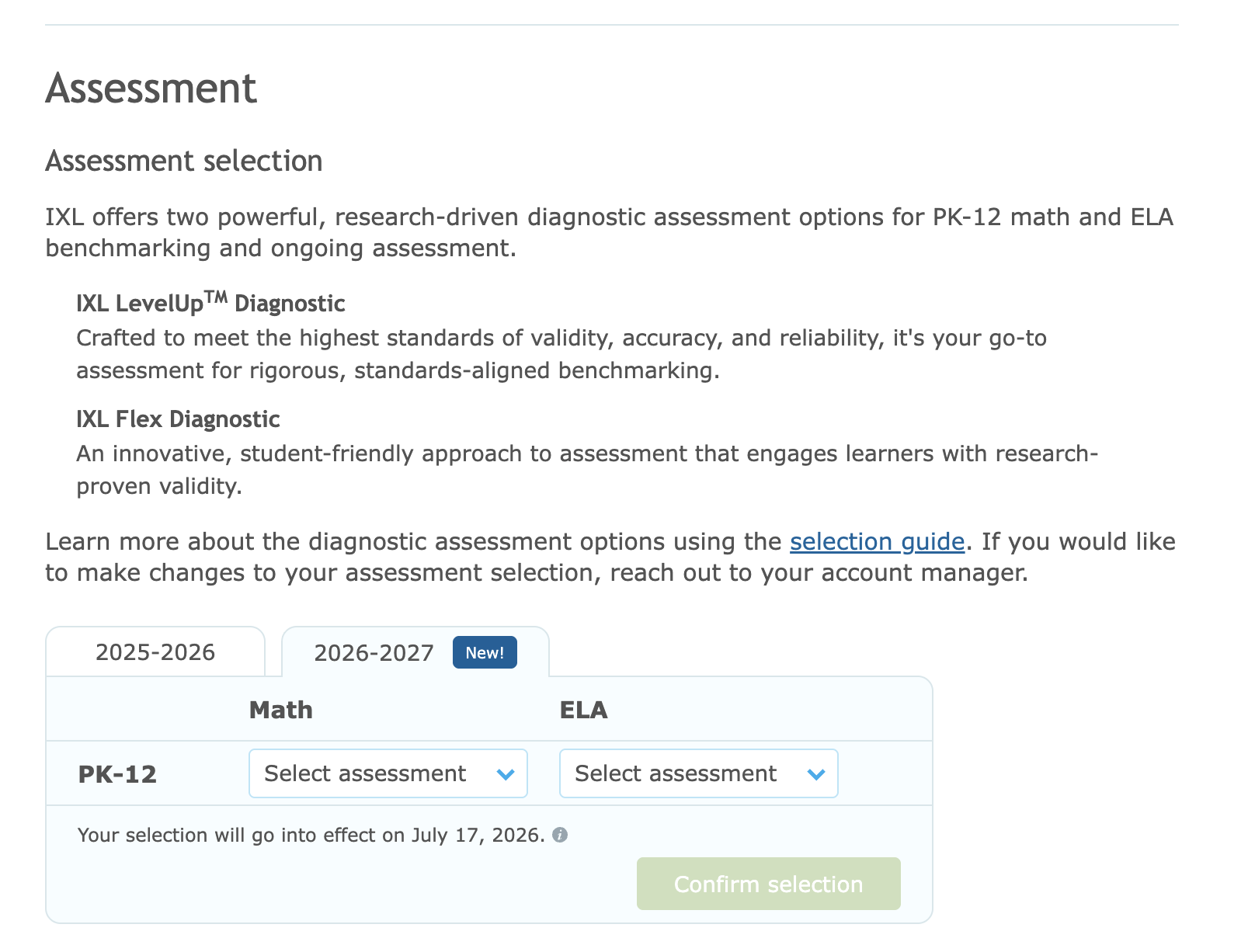
Schools and districts can now pre-select which IXL Diagnostic assessments they’d like to use for the 2026-27 school year! Choosing IXL assessments ahead of time helps ensure a smooth transition to next school year.
Primary administrators can select in advance whether they’d like to use the LevelUp™ Diagnostic or Flex Diagnostic for PreK-12 math and PreK-12 ELA by the 2026 back-to-school season. This selection is available on the Settings page of the Account tab. If schools and districts do not wish to make any changes to their current assessment selections, no action is needed.
If you need help deciding which assessment is right for your school or district, take a look at our LevelUp vs. Flex comparison chart. Assessment selection will continue to be editable through the first 90 days of school.
Schools and districts in Virginia that use the LevelUp Diagnostic will transition to the Virginia version of LevelUp with no additional action required.
Ultimate Summer Workbooks for grades PK-K, K-1, and 4-5
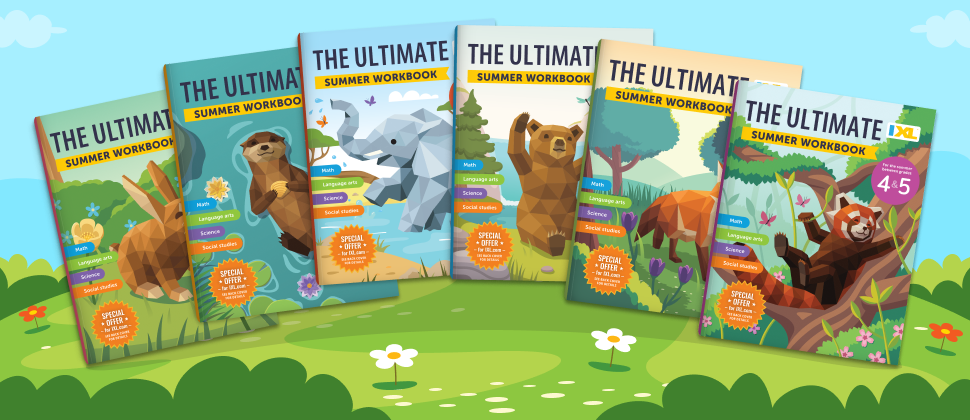
We’ve released three new IXL Ultimate Summer Workbooks for rising kindergarteners, 1st graders, and 5th graders! These workbooks reinforce key math, language arts, science, and social studies concepts through carefully crafted problems and delightful activities. With their release, our Ultimate Summer Workbook series spans grades K through 5.
IXL’s Ultimate Summer Workbooks keep learning simple, flexible, and enjoyable all summer long. They make it easy to build short, screen-free learning moments into learners’ days–whether that’s at the breakfast table, on a road trip, or during a quiet break at home. Plus, each skill in the workbooks pairs with an interactive skill on IXL.com, seamlessly connecting online and offline learning.
Feature updates
Multi-part reading question sets for IXL LevelUp™ ELA
Students can now encounter sets of multi-part reading questions, which include one passage followed by up to three related questions, throughout their LevelUp™ ELA Diagnostic assessments. Since these sets help students focus on one passage and apply their understanding across several questions (instead of having to read a new passage for every question), they will:
- Improve the student experience by lowering the reading burden during the test.
- Reduce overall testing time for ELA Benchmarks while maintaining score accuracy.
Each question within a multi-part set will follow the standard LevelUp time allotment: 3 minutes per reading question for grade PK-5 items and 5 minutes per reading question for grade 6+ items.

New visual design for skill plans and study plans
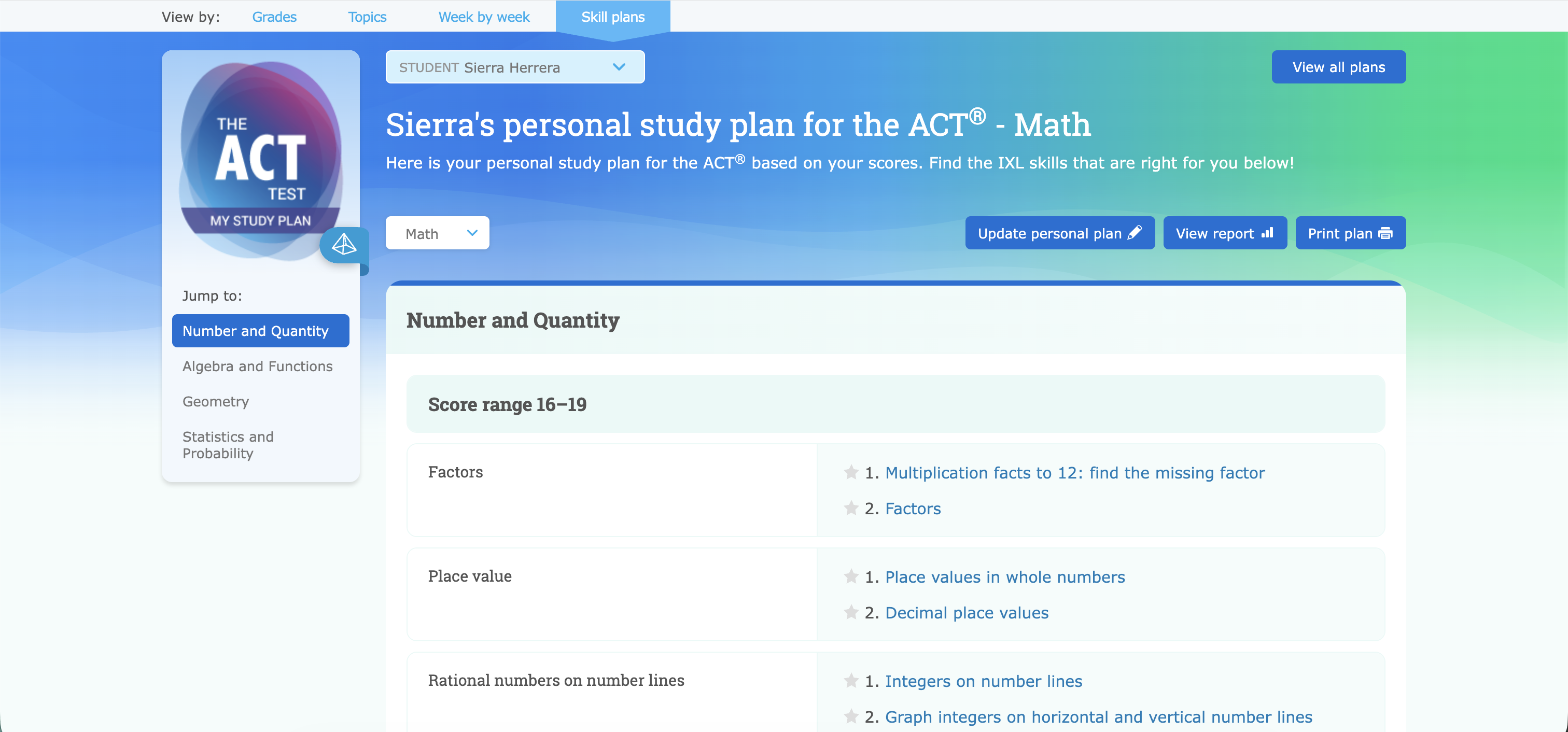
We’ve introduced a more vibrant, exciting design to our individual skill and study plan pages! In addition to making these plans more visually appealing, they’re also easier to navigate. The updated page layout and new sticky navigation bar helps educators, parents, and students easily jump between chapters or standards, and know exactly where they are in a plan.
Growth norms for IXL LevelUp Math
We are excited to release growth norms for LevelUp Math in K-8! Like the existing achievement norms, growth norms compare students to their peers, but they focus on growth over time. This technical report for the LevelUp Math diagnostic provides teachers and admin with a powerful tool to evaluate and make predictions about their students’ progress.
LevelUp Math Diagnostic HS standards reports for AR, KY, and MO
We’ve added LevelUp Math Diagnostic standards reports for Arkansas’, Kentucky’s, and Missouri’s high school math standards. The new courses included are:
- Arkansas – Algebra 1, Geometry, and Algebra 2
- Kentucky – Algebra 1, Geometry, Algebra 2, and Integrated Math 1-3
- Missouri – Algebra 1, Geometry, and Algebra 2
We will continue to release additional states’ high school standards reports in the coming months.
Skill plan updates and new skills
New math skills
We’ve released a dozen new math skills ranging from elementary school to Calculus:
- Solve problems involving the area and perimeter of rectangles (Grade 4)
- Make an estimate from sample data (Grade 7)
- Checkpoint: Linear expressions (Grade 7)
- Exponential growth and decay (Alg 1)
- Trigonometric ratios: word problems (Geometry)
- Solve a system of quadratic equations by graphing: parabolas (Alg 2)
- Classify local extrema using the second derivative test (Calculus)
- Areas of regions bounded by graphs and the y-axis (Calculus)
- Identify the graph of a function using its first and second derivatives (Calculus)
- Slope fields (Calculus)
- Solutions to differential equations using slope fields (Calculus)
- Relate Riemann sums and definite integrals (Calculus)
New English language arts skills
We released nearly two dozen new K-12 reading skills with a focus on literary analysis, informational text structure, and opinion and argument! Each skill includes unique content at each grade level and helps students build core comprehension skills across both fiction and nonfiction.
- Determine the topic and theme of a story (Kindergarten): Introduces early readers to identifying what a story is about and the lesson it teaches.
- Use text features (Kindergarten): Helps students understand book titles and simple graphics.
- Read along and identify the problem and solution in a story (Grades K-1): Helps students recognize key story structure.
- Identify the purpose of a text (Grades K-1): Builds students’ understanding of why a text was written.
- Read alone and identify plot elements (Grades 1-2): Supports students as they independently read literary texts and analyze key parts of the plot.
- Determine the order of events in informational texts (Grades 1-2): Strengthens students’ ability to follow sequence and understand how ideas unfold in nonfiction.
- Analyze persuasive passages (Grades 2-3): Gives students practice identifying opinion-based writing and understanding how authors try to convince readers.
- Analyze argumentative texts (Grades 4-5): Builds students’ ability to evaluate claims, reasons, and evidence in more complex opinion writing.
- Determine multiple themes of short stories (Grade 5): Challenges students to move beyond identifying a single theme and think more deeply about the multiple messages a literary text can convey.
- Read about business and technology, Read about famous places, and Read about history (Grades 7-8): Students build reading strategies for analyzing informational texts through engaging passages about famous entrepreneurs, inventions, locations, and historical events.
- Analyze passages from The Boy Who Harnessed the Wind: Part 1 and Analyze passages from The Boy Who Harnessed the Wind: Part 2 (Grade 8): Present students with passages from William Kamkwamba’s memoir about changing his Malawian community through the power of invention. These skills challenge students’ analysis skills with a variety of reading strategies questions.
- Analyze the impact of word choice on meaning and tone (Grades 11-12): A three-part skill in which students read short excerpts of sourced nonfiction texts, identify text evidence that develops a specific tone, and analyze how specific words and phrases develop meaning.
New Spanish language arts skills
We’ve released one new Spanish language arts skill for 4th grade: Leer fantasía con ilustraciones [Read fantasy with illustrations]. In this skill, students build reading comprehension as they explore fantasy stories brought to life with unique, whimsical illustrations.
New science skills
We’ve released several new science skills:
- What causes the tides? (Grades 6-8): Students learn how the Moon’s gravitational pull causes tidal bulges on Earth. They discover how high and low tides relate to Earth’s rotation, and apply this knowledge to interpret tidal data.
- Models of the atom (Chemistry): Students describe the changing models of the atom throughout history by interpreting the work of scientists Thomson, Rutherford, Bohr, and Chadwick.
- Factors affecting Yellowstone bison population dynamics (Biology): Students learn about a population of bison in Yellowstone National Park. Students interpret graphs to identify limiting factors for the population, determine which environmental factor seems to have the most limiting effect, and identify how limiting factors can be interrelated.
- Refraction of light (Physics): Students learn how light refracts as it passes from one medium to another through the application of Snell’s law.
- Other new skills include Active transport and Classify and describe eukaryotic organisms in biology, and Calculate work and Magnetic field calculations: solenoids in physics.
New social studies skills
We’ve released three new social studies skills:
- Fiscal and monetary policy (Civics): Students investigate how the government influences the economy through specific contractionary or expansionary policies that regulate the business cycle.
- Native peoples of the Great Plains and Native peoples of Alaska (Grades 6-8): Students learn about these Native cultural regions before European contact, with an emphasis on human-environment interaction.
New textbook skill plans
We’ve released skill plans for the following textbooks:
- HMH Into Science (Grades K-5)
- Savvas Elevate Science Tennessee (Grades 3-5)
New standards skill plans
We’ve released skill plans for grade 9 and grade 10 science standards for the Newfoundland and Labrador Canadian provinces.
New test prep skill plans
We’ve released our first skill plan aligned to the AZELLA (Arizona English Language Learner Assessment), a summative English language proficiency assessment! The plan provides skill recommendations based on English Language Proficiency Standard levels, so students have the appropriate skills to support their English language development. Our plans focus on the Reading and Writing domains of the test. Currently, the skill plans cover grades 2 and 3, and we plan to release plans for other grades in the future.
We’ve also released test prep skill plans for the Dynamic Learning Maps Essential Elements (DLM EEs) for math and ELA across grades K-12! The DLM EEs are designed to link the academic expectations of the Common Core Standards with content appropriate for students with the most significant cognitive disabilities. Many states have adopted the DLM EEs as their alternate standards for these students. Our skill plans can be used for ongoing instruction throughout the year or as test preparation ahead of alternate end-of-year state assessments.
Additional releases
New math, ELA, and SLA video tutorials
Math:
We’ve released 11 new math videos to expand our library, covering topics like uses for credit and reading a scale.
Language arts:
We’ve released 38 new ELA videos for skills across grades PK–5, and two new videos for recently released SLA skills! These videos cover topics like reading and spelling sight words and combining the main idea from two texts (combinar las ideas principales de dos textos).
Additional Takeoff grade 1 independent practice
We released new Takeoff independent practice pages for 1st grade units 11 and 12! With these units, we now offer independent practice for all 1st grade Takeoff units.
Teachers can find independent practice pages and answer keys within the materials list for the lessons where they’re available.
New Takeoff slide decks in Spanish
Last year we added a new resource for Takeoff, Takeoff instructional slides! Teachers can use these instructional slide decks to teach Takeoff lessons alongside provided student materials. We have full coverage of instructional slides for all K-5 Takeoff lessons in English, and now the following slides are available in Spanish in both the national and California editions:
- Kindergarten Unit 1
- Grade 1 Unit 1
- Grade 2 Unit 1
- Grade 3 Unit 1
- Grade 4 Units 1 and 15
- Grade 5 Units 1 and 14
These slides are available as downloadable PowerPoint files in the Materials section of each lesson.
New math skills for CA, UK, and AU
We released a large number of new math skills in our Canadian, Australian, and UK editions! Some examples include:
- In the grade 3 Canada skill Use equal groups and arrays to solve division word problems, students use models to help them represent and solve concrete problems. We have also released versions of this skill in Year 3 for Australia and the UK.
- In the UK Year 13 skill Find intervals of increase and decrease, students use derivatives to analyze the behavior of functions. We have also released this skill for calculus in Canada and Year 12 in Australia.