
At IXL, we never stop adding new features and skills to our award-winning teaching and learning platform, so you can always trust we’re on pace with students’ evolving needs. That’s why we compile a list of our top new features to help you—as a learner, educator, or parent—get the most out of IXL.
Keep reading below for a roundup of releases from February, including IXL SecureTest, the School Dashboard, a Standards Proficiency report for teachers, and more! To stay current with our latest updates, follow IXL on Facebook, Instagram, X, and LinkedIn.
Table of contents:
Major releases
IXL SecureTest
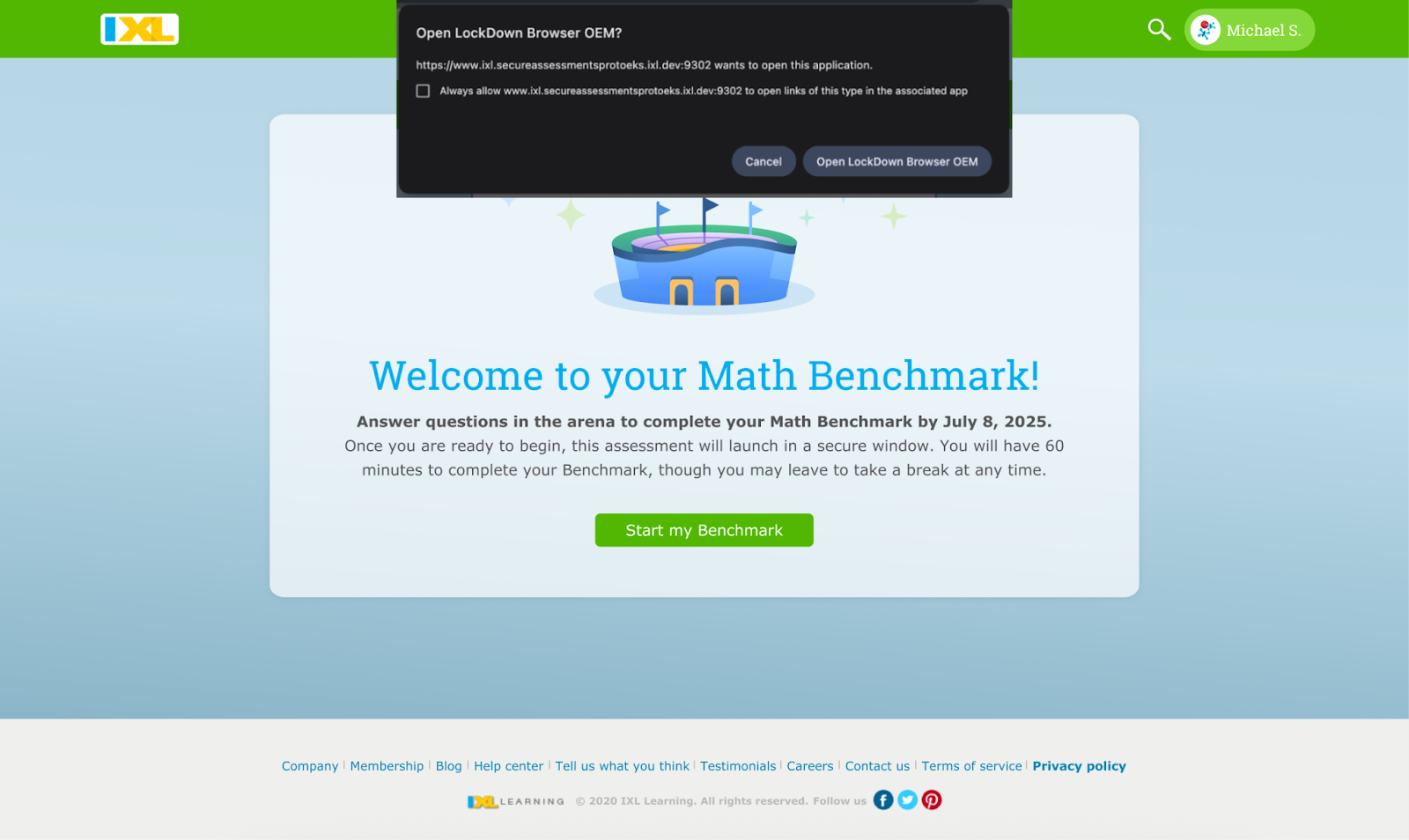
IXL SecureTest is now available for LevelUp™ Benchmarks, Universal Screeners, and Common Assessments! SecureTest prevents students from using unapproved functions during their assessment, such as AI tools, additional browser tabs, copy/paste, or programs that may impact assessment integrity.
Once enabled, students on the account can only access supported assessments on devices with SecureTest installed. Students will navigate to the assessment as usual on their normal Internet browser. When they are ready to begin, the assessment will open in the secure window.
Administrators can work with their IXL Account Manager to activate SecureTest. Learn more about activation, installation, and implementation on the IXL SecureTest hub.
School Dashboard
School-level administrators using the U.S., U.K., Canada, and Australia editions have a new sign-in landing experience on IXL: the School Dashboard! Now, school-level admins will have access to an at-a-glance view of student learning and activity across their school from the moment they sign in. Plus, with just a click they can dive deeper into anything they see that they want to investigate further.

Standards Proficiency report for teachers
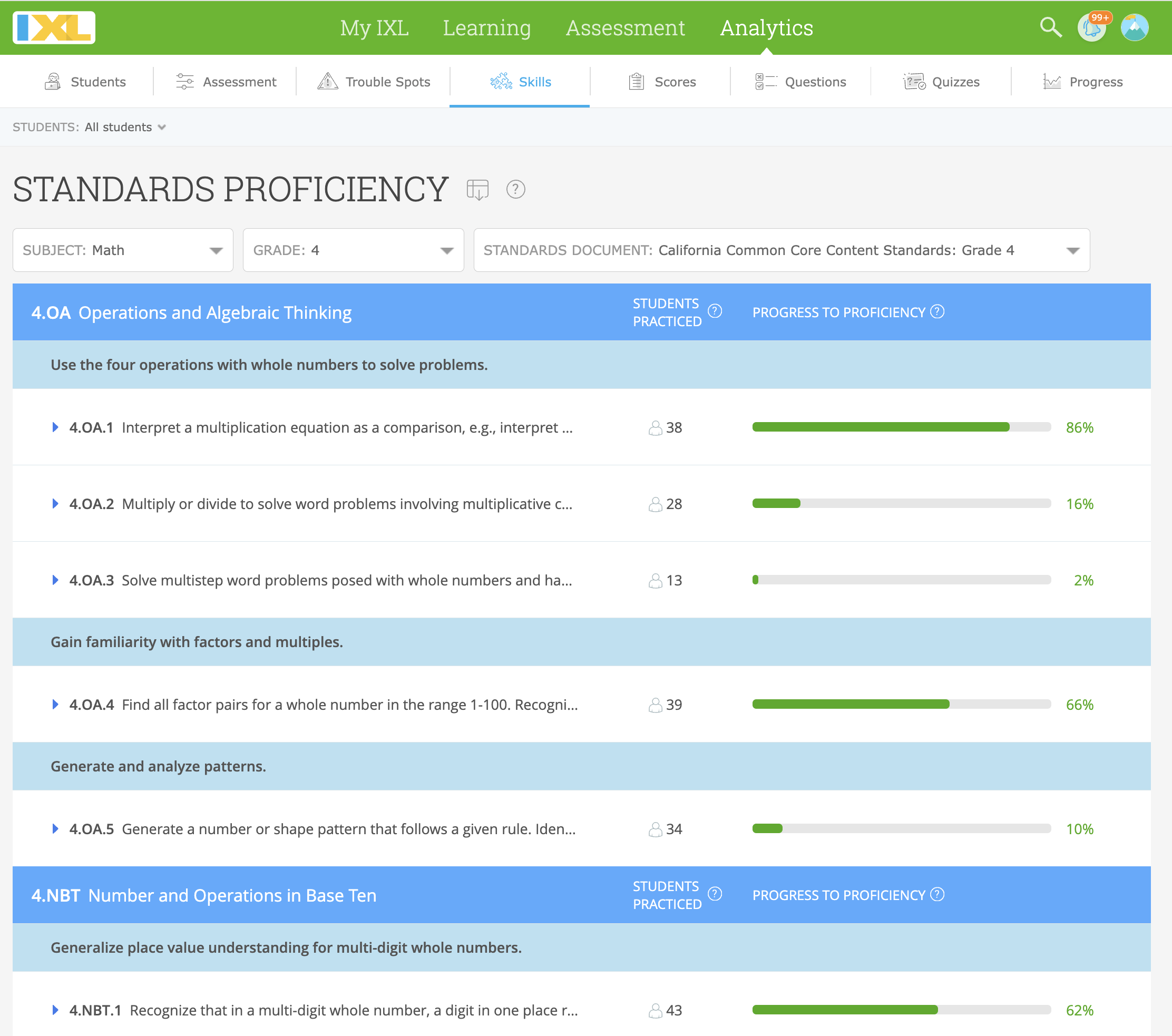
We’ve released a new Standards Proficiency report for teachers. This report shows teachers exactly how their students are performing on their state’s math and ELA standards. For each standard, teachers can quickly view their class’s progress to proficiency to identify which topics may need additional instruction.
Expanding a standard reveals the specific skills aligned to it, helping teachers see which skills students are succeeding or struggling in. Teachers can then drill down into those skills to see a breakdown of students who are proficient, not yet proficient, or who don’t yet have enough practice. This makes it easy to identify which students need targeted support and the skills they should focus on.
The report mirrors the Standards Proficiency reporting available to administrators, creating a shared view of standards progress and enabling more productive conversations between teachers and admins. It’s located in the Skills section in the Analytics tab.
Feature updates
Vocab Bowl teacher and student rankings administrator view
IXL admins can now see how their teachers and students are performing in the Vocabulary Bowl, the world’s largest academic competition! When logged into Vocabulary.com via IXL, admins can find ranked lists on the My Leaderboard page. District admins can view results across the district or filter down to individual schools.
We’re excited to provide admins with an easy way to motivate participation and recognize top performers within schools or districts.
New ‘group by’ filter on the Time Spent report for administrators
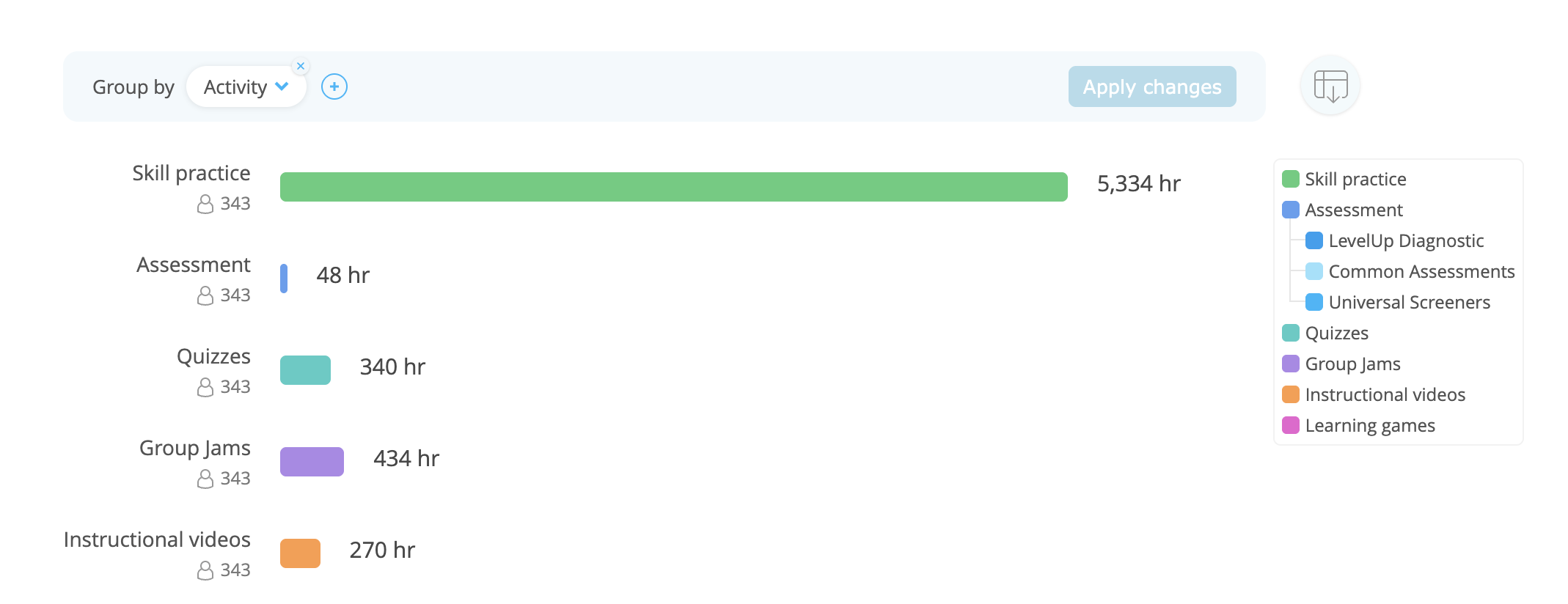
We have added a new way to analyze data on the Time Spent report for school and district administrators: grouping by activity!
Previously, data from all IXL activities (practice, assessment, quizzes, Group Jams, instructional videos, and learning games) was shown in one bar. Now, administrators will be able to drill into specific IXL activities and compare time spent across activities. This new group by option will be able to be used alongside existing group by selection options.
LevelUp Math Diagnostic standards report for North Carolina, Oklahoma, Oregon, Pennsylvania, and South Dakota high school standards
We’ve added LevelUp Math Diagnostic standards reports for North Carolina’s, Oklahoma’s, Oregon’s, Pennsylvania’s, and South Dakota’s high school math standards. The new courses included are:
- North Carolina – Math 1-3
- Oklahoma – Algebra 1 & 2 and Geometry
- Oregon – Algebra and Geometry
- Pennsylvania – Algebra 1 & 2 and Geometry
- South Dakota – Algebra 1 & 2, Geometry, and Integrated Math 1, 2, and 3
We will continue to release additional states’ high school standards reports in the coming months.
Common Assessment approval for district-level lead administrators
District-level lead admins can now create and approve all Common Assessments across their district, whether they are for a specific school, group of schools, or district-wide. Until now, assessments for more than one school had to be published by the Account Owner.
Expanding approval to include lead admins makes starting a Common Assessment a more flexible process, especially when the Account Owner is not involved in managing assessments. School-level lead admins can still create and approve assessments only for their individual school.
Quiz Library approval for district-level administrators
District admins, including the Account Owner, can now review and publish quizzes shared by teachers to the Quiz Library. Once approved, the resource will be published to that teacher’s school-level Quiz Library.
Previously, teacher-shared quizzes had to be reviewed by a school-level admin. This makes it easier for great resources written by teachers to be made available for other teachers to use across a school, especially when the school-level administrators are not involved in curating the Quiz Library.
Skill plan updates and new skills
Spring Spotlight skill plans are back
Our IXL Spring Spotlight skill plans for math and ELA are back! These skill plans provide 20 days of math and ELA skill recommendations for students in grades K-12. Spring Spotlight plans focus on the most critical topics at each grade level, offering a perfect opportunity for end-of-year review and spring test prep. We’ve also revised the Calculus plan to include recently released skills.
New math skills
We’ve released over a dozen new math skills spanning elementary school to high school:
- Income and gifts (Kindergarten)
- Write a number greater than or less than a given number – up to 100 (Grade 1)
- Count forward by twos, fives, and tens – up to 120 (Grade 1)
- Put numbers in order using number lines – up to 120 (Grade 1)
- Spending and saving (Grade 1)
- Place value – numbers up to 1,200 (Grade 2)
- Convert between standard and expanded form – up to 1,200 (Grade 2)
- Count halves, fourths, and eighths beyond one whole (Grade 2)
- Producers and consumers (Grade 2)
- Word problems involving area (Grade 3)
- Two-step word problems: represent and solve using strip models (Grade 3)
- Multi-step problems with fraction multiplication and division (Grade 5)
- Divide unit fractions and whole numbers: word problems (Grade 5)
- Add and subtract decimals and fractions (Grade 5)
- Checkpoint: Inequalities (Grade 6)
- Checkpoint: Proportional relationships (Grade 7)
- Find intervals of increase and decrease (Calculus)
New English language arts skills
We’ve released a ton of new skills for grades K-10:
Elementary school:
- Read short vowel stories, a decodable text skill that helps students apply decoding skills in controlled text. (Kindergarten & Grade 1)
- Two-part skills, such as Draw inferences and identify supporting details, that are scaffolded to help students first identify key details in the text and then use that information to make inferences. (Grades K-3)
- Three new decodable text skills, such as Read vowel team stories: ee and ea, focused on specific vowel teams to scaffold learning of long vowel patterns to longer texts. (Grade 1)
- Read words with digraphs and Read words with blends, giving students targeted practice with these phonics patterns. (Grades 1 & 2)
- Syllable segmentation skills, such as Segment two-syllable words: open and closed. (Grade 2)
- Segment consonant -le words, which rounds out our coverage of segmenting skills for all syllable types. (Grade 2)
- Read variant vowel and diphthong stories, supporting practice with more complex vowel patterns in decodable text. (Grades 2 & 3)
- Read long vowel stories, which focuses on multiple long vowel patterns, and Complete the sentence with affixed word, helping students recognize morphemes and decode longer words. (Grade 3)
- Our text structure skills have received a big update. These are now two-part skills with differentiated content across grades. Students identify the text structure and explain how it supports the author’s purpose. (Grades 3-5)
Middle school:
- Determine multiple themes of short stories, in which students identify two themes in a literary text, then identify text evidence to support the themes. (Grades 6-8)
- Choose the topic sentence that best captures the main idea has students select the best topic sentence for a given set of three bulleted ideas, allowing them to gain a better understanding of how a topic sentence should relate to and project the ideas in the paragraph that follows. (Grades 6-8)
- A new book study skill! In Analyze passages from The Hobbit: Part 1 and Analyze passages from The Hobbit: Part 2, students can journey to Middle-earth by reading passages from J. R. R. Tolkien’s The Hobbit and answering a variety of reading strategies questions. (Grade 7)
- Use academic vocabulary in context: literary helps students gain familiarity with new terms by reading literary texts and applying research-based vocabulary acquisition techniques. (Grade 7)
- Combine main ideas from two texts has students read two short informational texts and select the statement that best describes the main idea of both texts taken together. (Grade 7-8)
- In the two-part Draw inferences from literary texts skill, students make inferences with engaging literary texts, then identify details from the text to support the inference. (Grade 8)
High school:
- Students read short excerpts of sourced nonfiction texts in Analyze the impact of word choice on meaning and tone, a three-part skill in which students read short excerpts of sourced nonfiction texts, identify text evidence that develops a specific tone, and analyze how specific words and phrases develop meaning. (Grades 9-10)
New Spanish language arts skills
We’ve added seven new Spanish language arts skills! Here are a few highlights:
- Identificar los elementos de una historia [Identify story elements] (Grade 3): Students read imaginative literary passages to build foundational literary analysis skills. They identify key story elements, including setting, main character, and plot, by answering text-based questions that deepen comprehension.
- Leer sobre historia [Read about history] (Grade 4), students read long-form informational passages on captivating historical topics such as the Lighthouse of Alexandria and ancient Greek theater. They practice essential reading skills by answering questions focused on identifying key ideas and details, determining the meaning of vocabulary in context, and summarizing text.
- Combinar las ideas principales de dos textos [Combine main ideas from two texts] (Grade 5): Students practice synthesizing information from two related informational texts. This skill features relevant and engaging topics such as virtual reality, origami, and the Olympics.
New science skills
We’ve released several new science skills for early elementary school and high school:
- Seasonal daylight patterns (Kindergarten & Grade 1): Students make observations about how bright or dark the sky is at different times of day in the winter, spring, summer, and fall to draw conclusions about how daylight changes with the seasons.
- Design knee pads (Grades 1 & 2): Students identify a problem caused by discomfort during play. Through engaging illustrations, students first explore how living organisms protect themselves with hard and soft coverings, then mimic these natural adaptations by designing a pair of knee pads that will solve their problem. Students use the engineering design process to evaluate different materials and designs to optimize the knee pads’ effectiveness.
- Identify types of intermolecular forces between molecules (Chemistry): Students identify the intermolecular forces present between two molecules of the same substance and between two different molecules.
- Identify soluble and insoluble ionic compounds (Chemistry): Students use solubility guidelines to identify soluble and insoluble ionic compounds.
- Absorption and emission spectra (Physics) Students investigate absorption and emission spectra of atoms to understand how electrons move between discrete energy levels in an atom.
- DNA replication (Biology): Students learn how the structure of DNA allows it to serve as a template for its own replication and learn about the roles of a few main enzymes involved in the process of DNA replication.
- Protein synthesis: translation (Biology): Students learn about the biological process of translation and the role it plays in protein synthesis. They also learn how to use a codon chart, and apply their knowledge to predict the outcomes of transcription and translation.
New social studies skills
We’ve released a new elementary social studies skill and a new U.S. History skill:
- Region profile: the Southeast (Grades 4 & 5): Students investigate human-environment interactions by analyzing the region’s geography, climate, and economy.
- The abolition movement (U.S. History): Students explore efforts to end slavery; from the early colonial period through the Civil War, through both peaceful means and rebellion. Students also learn about abolitionist leaders and the movement’s legacy.
- The Vietnam War (U.S. History): Students analyze the conflict, focusing on its origins, U.S. involvement, and consequences.
Updated ACT skill plans
We’ve updated our ACT skill plans to ensure that learners are ready for the latest version of the ACT. This new “enhanced ACT” covers largely the same content, but offers a more streamlined experience, including a shorter testing time, more time per question, and a now-optional science section.
New textbook skill plan
We’ve released a skill plan for the social studies textbook TCI History Alive! – The World Through 1750 for grades 6-8.
New standards skill plans
We’ve released new skill plans for the following standards:
Math:
- Minnesota Academic Standards (adopted in 2022) (Integrated Math 1-3)
English language arts:
- Mississippi College and Career-Readiness Standards (2025) (Grades K-12)
- Texas English Language Proficiency Standards (Grades K-12)
Social studies:
- Maryland Social Studies Frameworks (revised in 2025) (Grades K-12)
We’ve also updated the skill alignments for the Delaware State Standards for Social Studies for grades 6-12. These changes reflect new clarification documents for their standards. We are planning to make similar updates for the K-5 plan in the future.
New test prep skill plans
We’ve released updated test prep skill plans to match content assessed with spring 2026 testing. These plans focus on the most crucial skills assessed on each test, and can be used for targeted preparation in the weeks leading up to the state assessments.
Math:
- SC Ready (Grades 3-8)
English language arts:
- Georgia Milestones (Grades 3-8)
- Minnesota MCA, Series IV (Grades 3-8 and 10)
Additional releases
New math, ELA, and SLA video tutorials
Math:
We’ve released 24 new math videos to expand our library, covering topics such as determining if two figures are similar and justifying your answer and adding and subtracting fractions with denominators of 10.
We’ve also released 4 new localized math videos for Canada.
Language arts:
We’ve released 8 new ELA videos covering skills in grades PK – 5, and three new videos for recently released SLA skills! These videos cover topics such as using spelling patterns to sort long e words, reading along about business and technology & identifying story elements (identificar los elementos de una historia).
Additional independent practice for Takeoff K-1
We’ve released the first Takeoff independent practice pages for K-1! We’re excited to start providing these pages for students in Grades K-1, starting with kindergarten units 6-9 and grade 1 units 1-6 and 8-10, so that teachers can start using the pages right away in their classrooms. We’ll continue releasing the remaining units for these grades gradually.
Teachers can find independent practice pages and answer keys within the materials list for the lessons where they’re available.
New Takeoff slide decks
Last year we added a new resource for Takeoff, Takeoff instructional slides! Teachers can use these instructional slide decks to teach Takeoff lessons alongside provided student materials. We’ve added new instructional slides to both the national and California editions of Takeoff:
- Kindergarten Unit 11
- Grade 1 Units 12-13
- Grade 3 Unit 13
- Grade 4 Units 14-15
- Grade 5 Units 13-14
With this release, we now have full coverage of instructional slides for all K-5 Takeoff lessons in the national and California editions!
Additionally, the following slides are now available in Spanish:
- Kindergarten Units 8-10
- Grade 1 Units 11-12
- Grade 2 Units 9-10
- Grade 3 Units 10-12
- Grade 4 Units 10-13
- Grade 5 Units 11-12
These slides are available as downloadable PowerPoint files in the Materials section of each lesson. We’ll continue releasing slide decks throughout the year.
New math skills for Canada, the UK, and Australia
We released several new math skills in our Canadian, Australian, and UK editions! Some examples include:
- Make pictographs with pictures (Canada Grade 1): Students count the number of illustrated objects in different categories and record this information in a table. We also released versions of this skill in Canada’s kindergarten and Australia’s Foundation.
- Add and subtract fractions and mixed numbers: multi-step word problems (UK Year 6): Students work with adding or subtracting fractions and mixed numbers with a variety of denominators (up to 12) to analyze real-world scenarios.