
At IXL, we never stop adding new features and skills to our award-winning teaching and learning platform, so you can always trust we’re on pace with students’ evolving needs. That’s why we compile a list of our top new features to help you—as a learner, educator, or parent—get the most out of IXL.
Keep reading below for a roundup of releases from March, including the IXL LevelUp™ Diagnostic for Virginia, the ability to reopen finished Common Assessments and Quizzes, bulk emailing of the Student Summary report and Diagnostic Action Plans to families, and more! To stay current with our latest updates, follow IXL on Facebook, Instagram, X, and LinkedIn.
Table of contents:
Major releases
IXL LevelUp™ Diagnostic for Virginia
We have released the Virginia edition of the IXL LevelUp Diagnostic, available for PK-12 math and ELA! This edition of LevelUp is approved as an Official Virginia Student Growth Assessment.
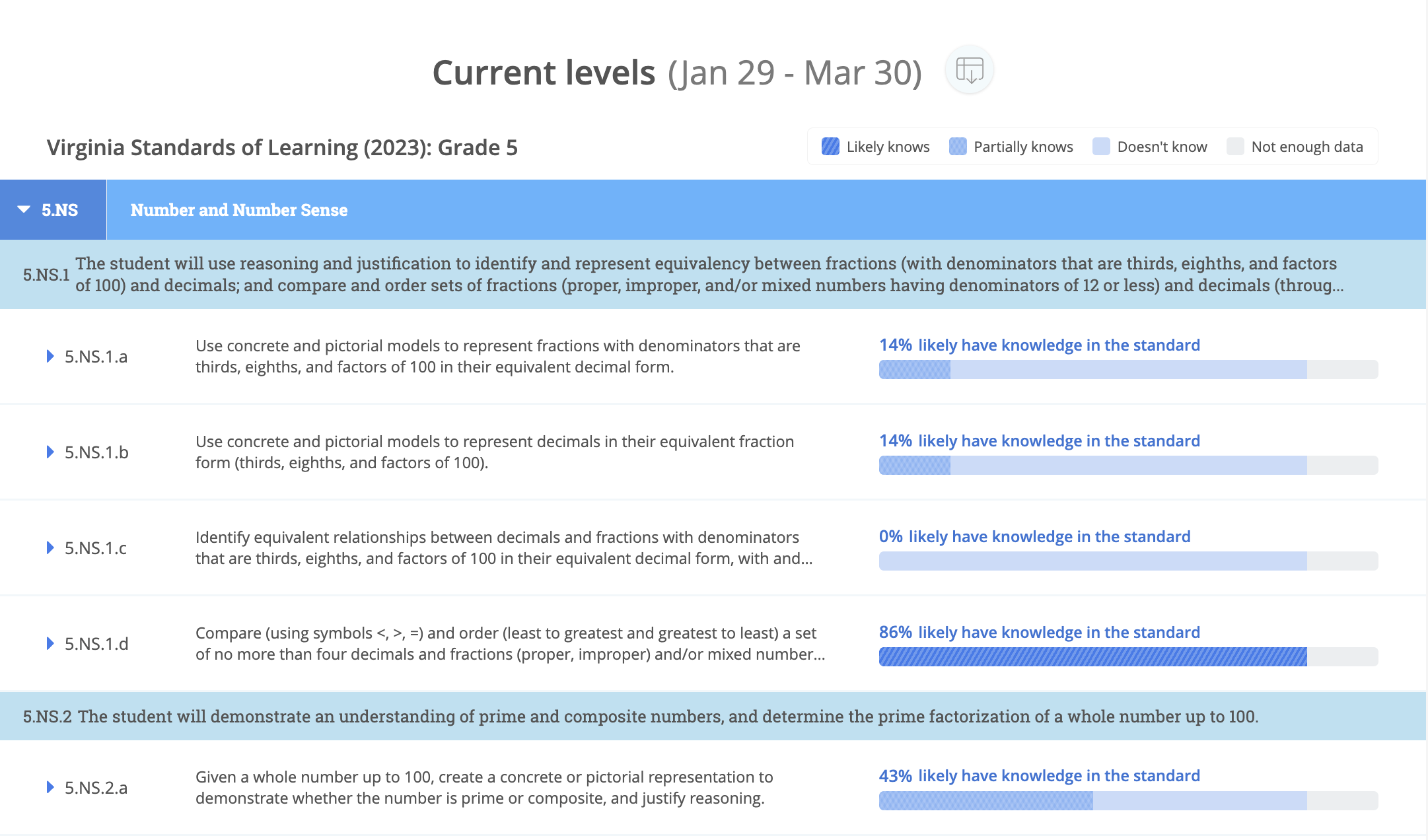
The LevelUp Diagnostic for Virginia includes all the functionality educators know and love from LevelUp, now aligned to the Virginia Standards of Learning (SOL). Additionally, Virginia LevelUp includes a new Virginia Standards Performance report, giving teachers and administrators clear visibility into how students are performing on SOLs based on their diagnostic results.
Virginia accounts currently using LevelUp will remain on National LevelUp for the remainder of this school year. Schools and districts that would like to switch to Virginia LevelUp mid-year should reach out to their IXL Account Manager, who can then coordinate with IXL Support to complete the transition.
Feature updates
Reopening Common Assessments and IXL Quizzes
Educators can now easily reopen Common Assessments and IXL Quizzes. If an assessment ended before some students had a chance to finish, or it was accidentally ended too soon, teachers and administrators can now make it available to students again without having to create a copy. This gives educators more flexibility with managing their list of assessments, and gives students who were absent or needed more time a fair opportunity to complete their work.
Reopening a teacher-created IXL Quiz will make it immediately available for students who were assigned to that quiz and did not finish. When reopening a Common Assessment, admins can schedule the start of a new assessment window, starting as early as the next day. Once a quiz or assessment is reopened, students will be able to see any of their previously saved answers to pick up exactly where they left off.

Bulk email Student Summary reports and Diagnostic Action Plans to families
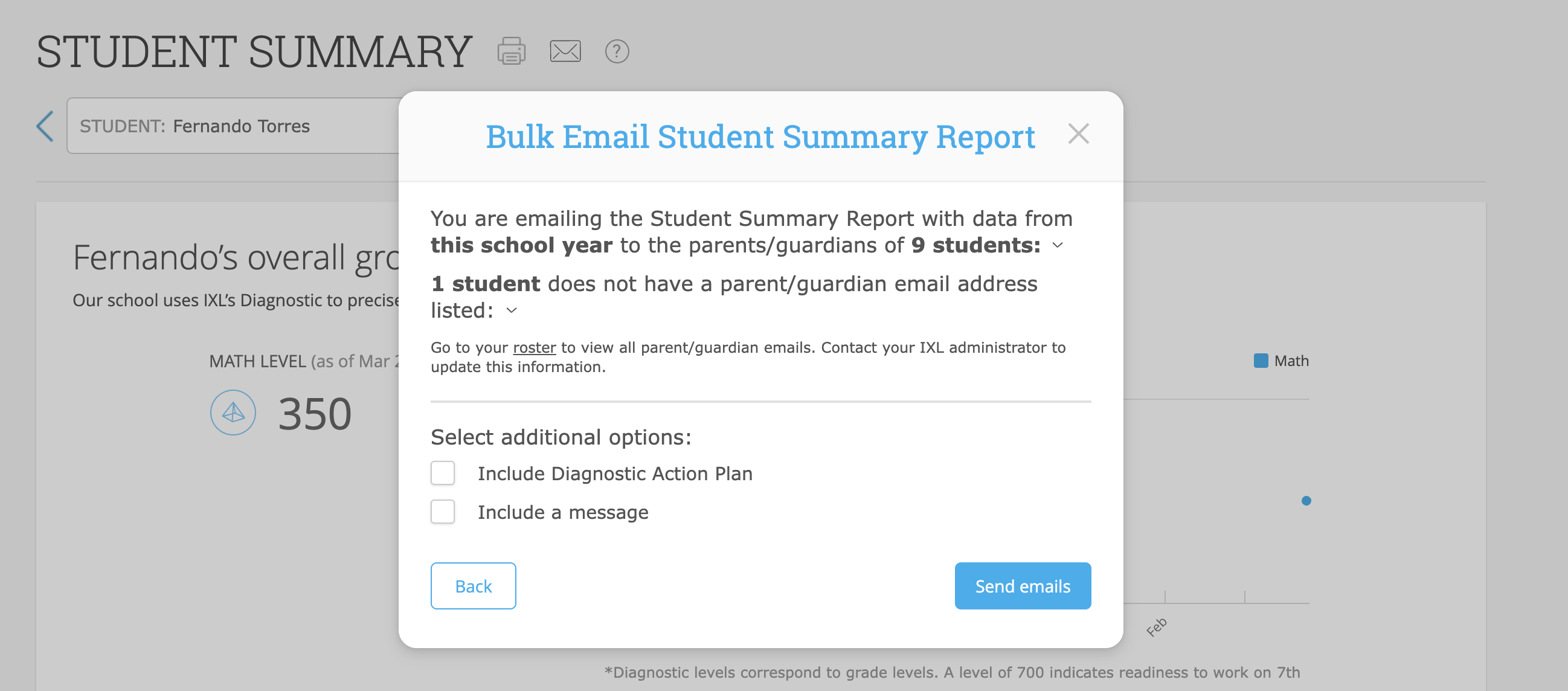
Teachers can now bulk email the Student Summary report and Diagnostic Action Plans to the parents and guardians of all their students, or students in a specific class or course. Previously, teachers had to email these reports one student at a time. This update makes it faster and easier to share updates with families and keep them informed about student progress.
Teachers can initiate a bulk email from the Student Summary report by clicking the envelope icon, then selecting the bulk email link in the bottom-left corner of the page. Before sending the reports, teachers can also add an optional message for all recipients and choose to include students’ Diagnostic Action Plans along with the report.
This feature is available to teachers in all English-language editions of IXL.
LevelUp Math Diagnostic high school standards reports for Georgia, Idaho, Iowa, Utah, and Wyoming
We’ve added LevelUp Math Diagnostic standards reports for Georgia’s, Idaho’s, Iowa’s, Utah’s, and Wyoming’s high school math standards. The new courses included are:
- Georgia – Algebra, Geometry, and Advanced Algebra
- Idaho – Algebra 1, Geometry, Algebra 2, and Integrated Math 1-3
- Iowa – Algebra 1, Geometry, and Algebra 2
- Utah – Integrated Math 1-3
- Wyoming – Algebra 1, Geometry, Algebra 2, and Integrated Math 1-3
We will continue to release additional states’ high school standards reports in the coming months.
Upgraded IXL video player
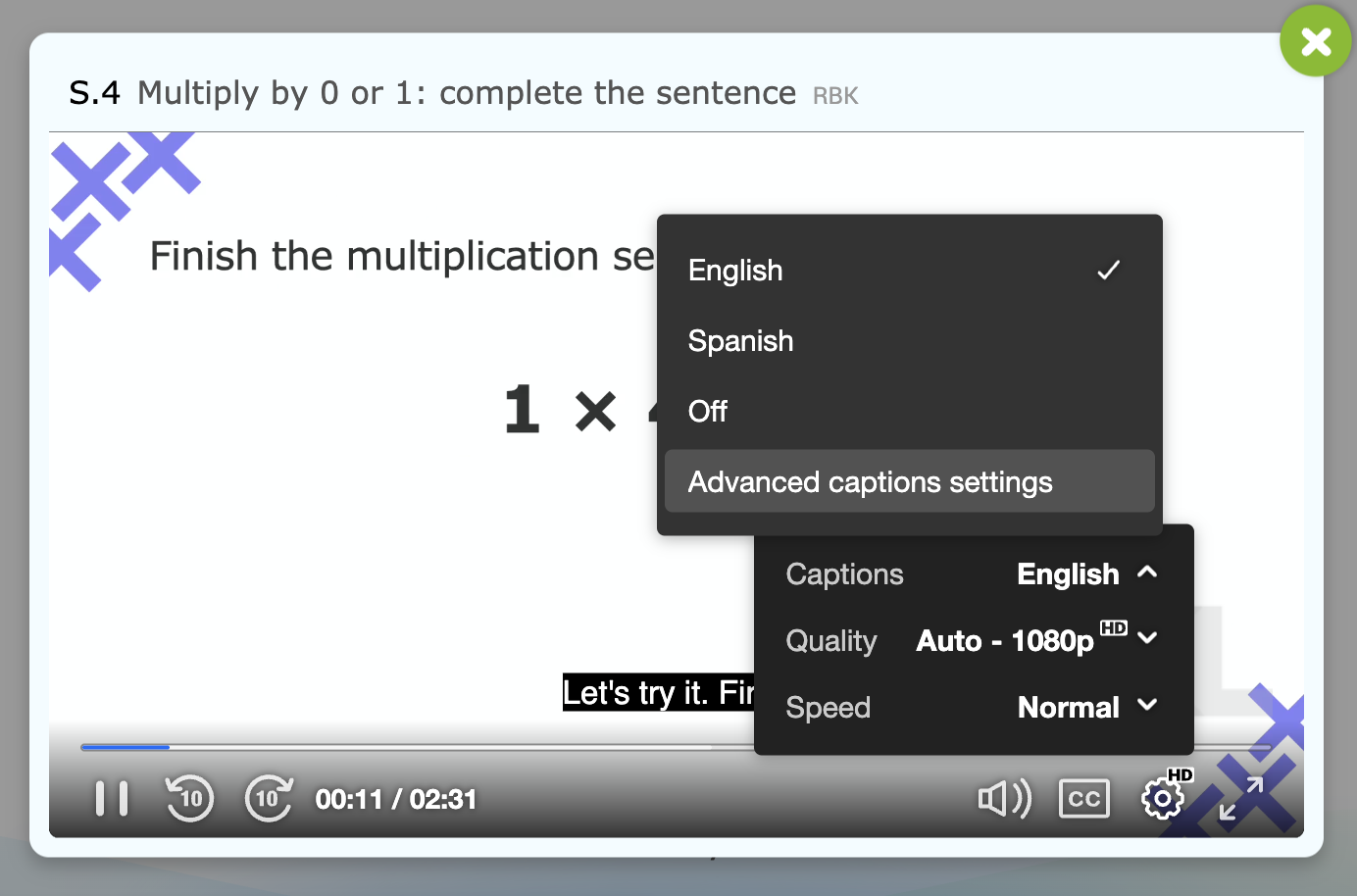
IXL video tutorials and IXL Minis now have an enhanced video player! This upgraded player has a new interface and features advanced caption controls for improved accessibility.
Skill plan updates and new skills
New StudyWise plans for Minnesota NWEA MAP Growth
IXL’s StudyWise tool turns students’ previous test scores into their own personalized study plans. We’ve expanded our StudyWise support for Minnesota NWEA MAP Growth to include high school math (Algebra 1, Geometry, and Algebra 2). These plans were created in partnership with NWEA.
Teachers and students can now input scores into StudyWise to generate personalized plans that align with these Minnesota MAP tests. As usual, admins can also request bulk uploading scores for their school. Teachers and students who previously created Minnesota MAP study plans will continue to see those plans in their account.
New math skills
We’ve released 19 new skills for elementary school math, including a batch of financial literacy skills, as well as a new Checkpoint for 6th grade:
- Wants and needs (Kindergarten)
- Ways to earn income (Kindergarten)
- Skills for a job (Kindergarten)
- Giving to charity (Grade 1)
- Income (Grade 1)
- Borrowing and lending money (Grade 2)
- Spending and saving money (Grade 2)
- Cost to produce an item (Grade 2)
- Deposits and withdrawals (Grade 2)
- Compare equal parts (Grade 2)
- Separate equal groups (Grade 2)
- Place numbers on number lines – up to 1,200 (Grade 2)
- Perimeter and area word problems (Grade 3)
- Measure liquid volumes – customary units (Grade 3)
- Interpret dot plots (Grade 3)
- Make halves, thirds, fourths, sixths, and eighths in different ways (Grade 3)
- Use strip diagrams to represent and solve multi-step addition and subtraction word problems (Grade 4)
- Solve word problems involving number patterns in tables (Grade 4)
- Area and perimeter: multi-step word problems with unit conversions (Grade 5)
- Checkpoint: Solve one-step inequalities (Grade 6)
New English language arts skills
We released some new K-5 reading strategy skills and two new nonfiction book study skills for 6th grade:
- Choose the picture that matches the descriptive sentence (Grades K-2): A visually engaging skill that helps students interpret descriptive language and build the habit of creating mental images as they read or listen to text.
- Identify and analyze the main idea of a passage (Grades 3-5): A two-part main idea skill that builds on our popular determine the main idea skills. These new skills guide students to identify the main idea and support their understanding with evidence from the text.
- Analyze plot elements (Grades 4-5): A five-part skill that helps students examine key components of plot—exposition, rising action, climax, falling action, resolution, and the central conflict.
- Identify the author’s purpose and message (Grades 4-5): Builds on the Identify the purpose of a text skills by helping students understand how an author’s purpose connects to the text’s overall message.
- Analyze passages from The Great Fire: Part 1 and Part 2 (Grade 6): Presents students with passages from Jim Murphy’s harrowing account of the Great Chicago Fire and challenges their analysis skills with a variety of reading strategies questions.
New Spanish language arts skills
We’ve added six new Spanish language arts skills! A few highlights are:
- Leer ficción histórica con ilustraciones [Read realistic fiction with illustrations] (Grade 3): Students read short stories paired with creative illustrations that bring the scenes to life. They then answer questions to check and deepen their understanding of each story.
- Combinar las ideas principales de dos textos [Combine main ideas from two texts] (Grade 4): Students practice synthesizing information from two related informational texts. These engaging texts cover topics like international space agencies, how Olympic medals are made, and famous urban murals.
- Identificar estructuras textuales [Identify text structures] (Grade 5): Students read short informational passages and are then asked to identify patterns of organization. The structures covered include cause and effect, compare and contrast, sequence, problem and solution, and description.
New science skills
We’ve released six new science skills! Here are a few highlights:
- Introduction to energy (Grade 4): Students use the real-world scenario of a soccer game to describe what energy is, identify what forms it can take, and identify how it is transferred from object to object or transformed from one form to another.
- Calculate acceleration using Newton’s second law of motion (Grades 6-8): Students apply their understanding of Newton’s second law of motion—specifically, that the acceleration of an object is equal to the net force on the object divided by the object’s mass—to solve for acceleration.
- Aerobic cellular respiration, anaerobic cellular respiration, and fermentation (Biology): Students learn how some organisms obtain energy via anaerobic respiration and fermentation. They compare these processes with aerobic respiration, explain how oxygen requirements influence microbial growth, and evaluate how the products of these processes contribute to human applications and the cycling of carbon and other matter in ecosystems.
New social studies skills
We’ve released four new social studies skills:
- Native peoples of the Pacific Northwest and Native peoples of the Great Basin and Plateau (Grades 6-8): Students learn about the Native cultural regions before European contact, with an emphasis on human-environment interaction.
- World War II: the war begins (Grades 7-8): Students analyze the origins of the global conflict and how the United States entered the war.
- World War II: the European theater (U.S. History): Students investigate the conduct of World War II in Europe, from its beginnings with the invasion of Poland, through the Allied counteroffensive on D-Day, to the discovery of concentration camps and the end of the war in Europe.
Updated standards skill plans
We’ve updated the skill plans for the Delaware State Standards for Social Studies (K-5) to reflect the most recent clarification documents from the state.
We’ve also updated our Mississippi College- and Career-Readiness Standards for Mathematics to reflect the updated 2025 language. These small but significant changes are now reflected in standards skill plans, Takeoff alignments, and the LevelUp Diagnostic Standards Performance report.
New test prep skill plans
We’ve released new skill plans for the New Hampshire Statewide Assessment System (NH SAS). These skill plans focus on the most crucial skills assessed on each spring 2026 test, and can be used for targeted preparation in the weeks leading up to the state assessments.
- NH SAS Math (Grades 3-8)
- NH SAS Language Arts (Grades 3-8)
- NH SAS Science (Grades 5 & 8)
We’ve also changed some of our state test prep skill plans for Alabama, Indiana, Pennsylvania, and Texas to match their updated end-of-year tests for this spring.
- ACAP (Grades 2-8 ELA)
- ILEARN Summative (Grades 3-8 math and ELA)
- PA Keystone (Biology)
- STAAR (Biology)
Additional releases
Takeoff Texas edition
We’re thrilled to announce the release of our third state-specific version of Takeoff, Takeoff for Texas!
Here’s what makes the Texas edition special:
Built exclusively for Texas classrooms: Takeoff Texas is designed from the ground up to meet the unique needs of the Lone Star State. From Texas-specific teacher guides and daily planners to glossaries and unit-level family levels, this edition has everything Texas educators and learners need. Not only does this edition address all content standards, it also incorporates all of the process standards. Alignments to the TEKS can be found at the unit and lesson level.
Language support strategies aligned to the ELPS: Located in the Additional Supports tab of each lesson, language support strategies include lesson-specific strategies and scaffolds that are aligned to the ELPS (English Language Proficiency Standards) and organized by ELPS proficiency level. Teachers receive clear, targeted guidance on how to support emergent bilingual students in building both content knowledge and language proficiency.
Texas Takeoff Lessons for signed-in IXL users: Signed-in Texas users will have access to some Texas Takeoff lessons, included with their IXL subscription. Located on our IXL math lesson pages in grades K-5, these lessons are handpicked from the Takeoff Texas edition and aligned to the TEKS.
The Texas edition, like the California and Florida editions, will be opt-in only. Schools and districts that would like to use it can request to switch from the national version. This ensures that educators already using Takeoff can finish the school year without interruption.
Additional Takeoff K-1 independent practice
We released new Takeoff independent practice pages for kindergarten units 10-11 and 1st grade units 7 and 13! We’re excited to offer these new units of independent practice for kindergarten and first grade learners using Takeoff.
Teachers can find independent practice pages and answer keys within the materials list for the lessons where they’re available.
New Takeoff slide decks in Spanish
Last year we added a new resource for Takeoff, Takeoff instructional slides! Teachers can use these instructional slide decks to teach Takeoff lessons alongside provided student materials. We have full coverage of instructional slides for all K-5 Takeoff lessons in English, and now the following slides are available in Spanish:
- Kindergarten Unit 11
- Grade 1 Unit 13
- Grade 2 Unit 11
- Grade 3 Unit 13
- Grade 4 Unit 14
- Grade 5 Unit 13
These slides are available as downloadable PowerPoint files in the Materials section of each lesson.
New math skill for Australia
We have a new math skill for the Australian edition of IXL! In the new Year 8 skill Percent error: word problems, students analyze real-world scenarios to quantify the uncertainty associated with measurements and predictions.
New curriculum alignment for New Zealand
We’ve released updated skill plans for the following grade levels to align to the revised New Zealand standards taking effect in the 2026 school year.
- ELA – New Zealand Curriculum (updated for 2026) – Years 1-6
- Maths – New Zealand Curriculum (updated for 2026) – Years 1-8
In maths Years 1-8, we’ve also made significant revisions to the grade-level landing pages to correspond to the revised standards.