
“It’s not where you start, but where you finish,” says Dr. Bryant Shaw, Principal of Casey Middle School. With most students entering below grade level and the school approaching turnaround status, Casey needed a way to rebuild math foundations without lowering expectations. IXL Math became the engine for individualized practice, academic growth and school-wide accountability. When the program was paused, scores dropped; when it returned, measurable growth resumed.
The Challenges
Casey Middle School is one of the most diverse schools in the Boulder Valley School District, a district nationally recognized for high performance. While the district average for free and reduced lunch is under 20%, approximately 65% of Casey students qualify. Most incoming sixth graders enter below grade level in math, with some cohorts approaching nearly 100% below proficiency. In 2022, with performance declining, Casey was placed on priority improvement status. Without measurable progress, the school faced the possibility of turnaround—a rare designation within the district.
When Dr. Shaw became principal in 2023, he inherited a school with significant foundational skill gaps and limited systems for ongoing progress monitoring. Although the school had adopted a new secondary math curriculum, there was no agreed-upon scope and sequence and no consistent structure for monitoring skill development or closing learning gaps at scale. Additionally, teachers needed to provide both targeted, individualized math practice and grade-level instruction with limited instructional time.
To add to the challenge, many students faced significant barriers to academic support outside of school, including limited computer and internet access, inconsistent adult academic guidance, and competing home responsibilities. Closing foundational gaps could not depend on at-home reinforcement; it had to be built into the school day.
The Solution
When Dr. Shaw became principal in 2023, he focused on building a performance-driven system centered on deliberate practice and measurable growth. IXL Math became the foundation for that system, not as a supplemental tool, but as a consistent structure for individualized practice, fluency development, and real-time mastery tracking across grade levels.
Rather than replacing core instruction, IXL was embedded into Casey’s existing math framework to strengthen it. Students engaged in diagnostic-driven skill plans aligned to grade-level standards while also addressing unfinished learning from prior grades. Clear mastery expectations ensured that students built fluency before progressing, reinforcing the principle that improvement requires sustained practice. Dr. Shaw says, “You can’t get better at something without doing the work. IXL gives them the individualized practice they need.”
Dr. Shaw integrated IXL intentionally across the school day. Dedicated time during intervention blocks, advisory periods, and after-school programming provided consistent opportunities for targeted skill development. Teachers used real-time data to form small groups, provide immediate feedback, and guide one-on-one conversations about student progress. What began as a tool for practice evolved into a schoolwide system for accountability, differentiation, and visible growth.
Here’s how math teachers are using IXL at Casey Middle School:
- IXL is embedded across settings (during intervention blocks, advisory periods, after-school programs, and core math instruction) to reinforce and extend learning.
- Teachers assign diagnostic-driven skill plans that target both current grade-level standards and gaps from prior grades.
- Mastery benchmarks ensure students demonstrate fluency before moving on to new skills.
- IXL is used for warm-ups, targeted skill practice, and CMAS preparation.
- Teachers rely on real-time data to form small groups and hold individualized conferences about academic growth.
- Structured “Arena Days” provide focused, schoolwide time for individualized skill building and progress tracking.
The Results
Following schoolwide implementation in 2023, Casey began to see measurable improvement in math performance. Among Casey students who used IXL Math, scores on the Colorado Measures of Academic Success (CMAS) assessment rose by an average of seven points, topping the rest of the district, which averaged only four points of growth. Additionally, more students reached state proficiency benchmarks. For a school where most students entered below grade level, the trajectory shift was significant.
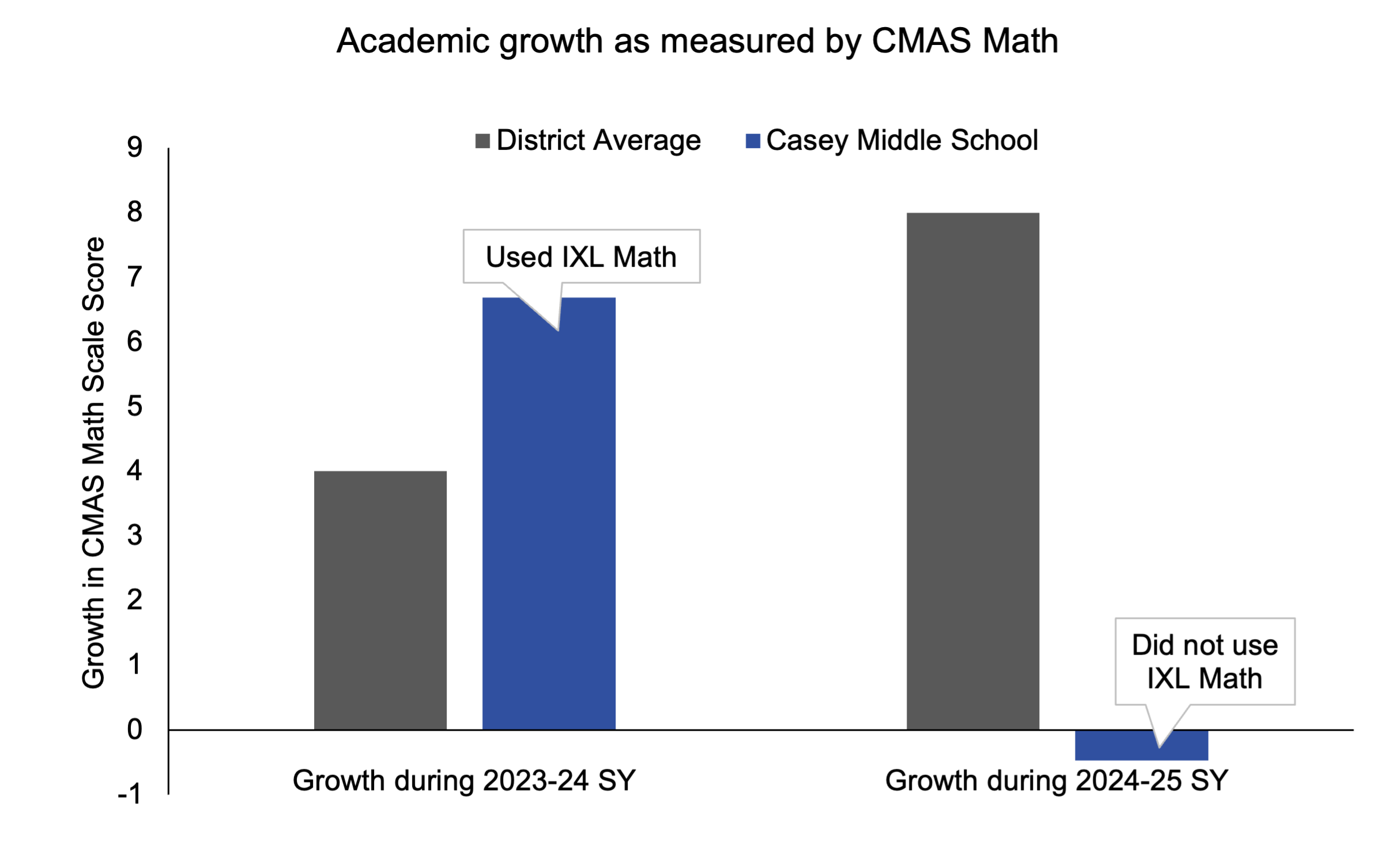
The impact became even clearer during the 2024–2025 school year, when IXL was temporarily removed. During that period, the school saw a noticeable decline in math performance data, registering little to no student growth on CMAS as the district averaged eight points of improvement.
When IXL was reinstated during the 2025-26 school year, growth trends rose again. On the CMAS, Casey students who used IXL Math with fidelity scored an average of six points higher than students who didn’t meet the recommended amount of IXL usage. While multiple factors influence student achievement, the pattern reinforced the role that structured, individualized practice and real-time proficiency tracking played in sustaining progress.
Beyond test scores, teachers report meaningful gains in student confidence and engagement. Students can articulate their academic standing, track their own growth, and set measurable goals. Conversations about performance aren’t limited to benchmark windows; they happen continuously. For many students, especially those who began multiple grade levels behind, visible progress has shifted mindsets from “I’m not good at math” to “I can improve if I put in the work.” Growth at Casey is no longer aspirational; it is visible, measurable, and shared by students and staff alike.
Download the case study PDF here! Interested in bringing IXL to your school? Visit https://www.ixl.com/membership/teachers/trial for a free 30-day trial.