At IXL, we never stop adding new features and skills to our award-winning teaching and learning platform, so you can always trust we’re on pace with students’ evolving needs. Each month we compile a list of our top new features to help you—as a learner, educator, or parent—get the most out of IXL.
Keep reading below for a roundup of releases from September, including the Fluency Zone for Canada, IXL Games suggestion, new filters for the Skill Usage and Skill Proficiency reports, and more! To stay current with our latest updates, follow IXL on Facebook, Instagram, X, and LinkedIn.
Table of contents:
- Major releases
- Feature updates
- Skill plan updates and new skills
- Additional releases
- New math, ELA, and SLA video tutorials
- Takeoff Grade 6 Units 4 and 5 available
- Trouble Spots review and Instant Review on Takeoff
- Unit assessment progress visible in Takeoff Live Classroom
- Takeoff Grade 6 alignment to PA standards
- Spanish translation for Takeoff Grade 6 Units 3 and 4
- New Takeoff slide decks in Spanish
- New math and science skills for CA, UK, and AU
Major releases
Fluency Zone for Canada
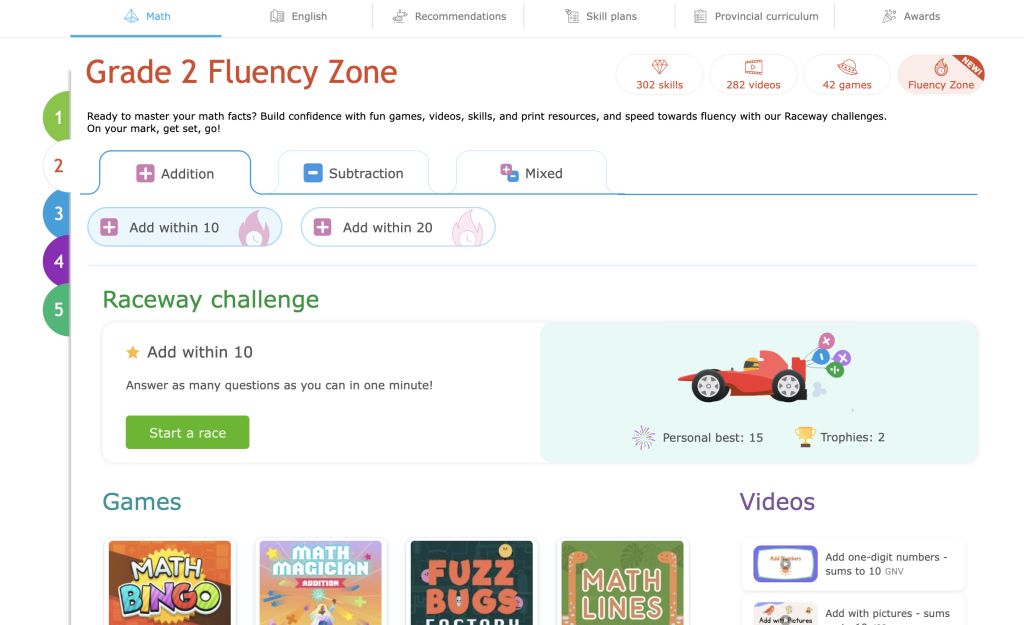
The Fluency Zone is a hub to help students build the key skills of addition, subtraction, multiplication, and division. Now it has arrived in the Canadian edition of IXL!
The Fluency Zone offers a complete toolkit for developing fact fluency, serving up a variety of activities including videos, games, worksheets, and skills to support every step of an IXLer’s math fact journey.
It’s also home to the IXL Raceway, which hosts fast-paced math challenges that get learners to solve as many problems as they can in one minute. For teachers and parents, these challenges help track students’ solving speed, accuracy, and growth over time.
Feature updates
IXL Games suggestion
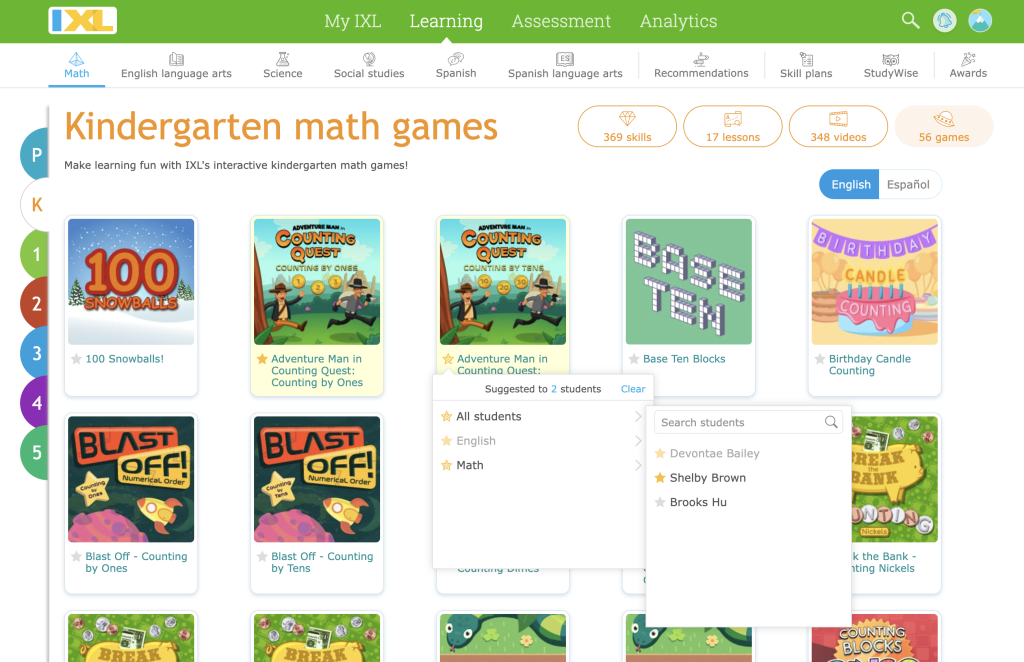
Teachers and parents can now suggest specific IXL Games to students, just like they can suggest skills! Suggested games will appear on student dashboards, so learners can find them easily and navigate to them with just one click. This feature is available for the US, CA, UK, and AU editions of IXL.
Selecting the star icon next to a game’s name will suggest it. Teachers can suggest games to their whole roster, specific classes, or individual students, and parents can suggest games to individual children. If a student has games hidden, suggested games will not appear on their dashboard.
New filters for Skill Usage and Skill Proficiency reports
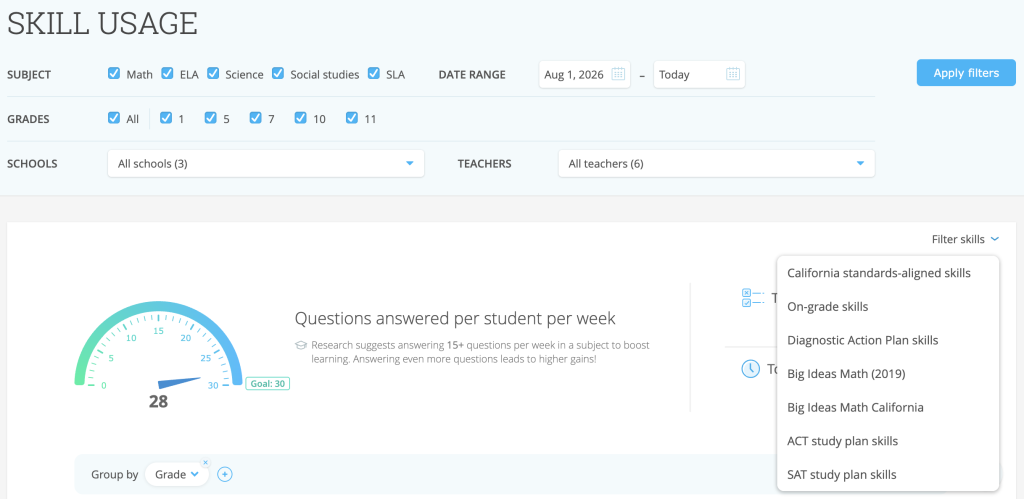
Administrators have a set of powerful filters for the Skill Usage and Skill Proficiency reports to ensure students are using IXL in a way that matches district goals. Now admins can use two new filters to view data from either skills aligned to spotlighted skill plans or skills in students’ personalized study plans.
Each spotlighted skill plan will appear as its own filter option, making it easy to see how students are practicing and progressing on the skills covered by a specific plan. This filter is available for the US, CA, UK, and AU editions of IXL.
Bulk-uploaded study plan types will also appear as their own filter options. Supported assessments include ACT®, Florida Assessment of Student Thinking (FAST), ILEARN ELA Checkpoints, ILEARN Math Checkpoints, PreACT, and SAT®. This filter is available for the US edition of IXL.
SAT® is a trademark owned by the College Board and ACT® is a trademark of ACT Education Corp. Their use here is for identification purposes only. No claim of affiliation or endorsement is made.
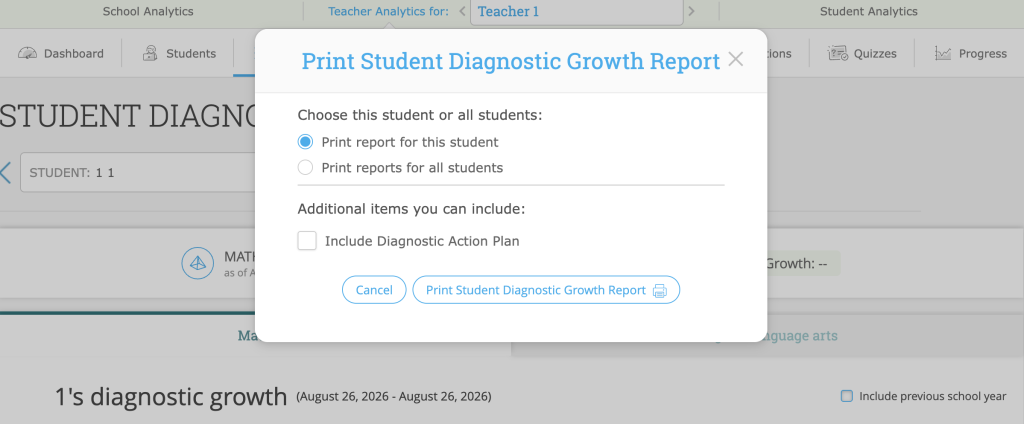
Printing for Student Diagnostic Growth report
Teachers, administrators, and students can now print the Student Diagnostic Growth report directly from assessment analytics. This makes it easier to share student growth data.
To print, select the printer icon to the right of the report name at the top of the page. Teachers can print reports for individual students or for their full class, with the option to attach each student’s Diagnostic Action Plan.
LevelUp ELA Diagnostic standards report for IA and MD
We now display the 2024 Iowa standards and the 2025 Maryland standards in standards reports for the LevelUp ELA Diagnostic. This change supports administrators and teachers in transitioning to these newer learning standards.
Skill plan updates and new skills
New math skills
We’ve released a few new Calculus skills! Some examples include:
- Find limits using tables: Students use a table of values to analyze how a function f(x) behaves as the variable x approaches a particular value. Limits are a fundamental concept in Calculus, and this skill gives students concrete, numerical practice working with them.
- Analyze functions involving integrals: Students apply the fundamental theorem of calculus in order to discover key features of a given function, such as where the function is increasing or decreasing, and how its graph curves.
New English language arts skills
We’ve added 27 new ELA skills, including:
- Blend syllables together to make a compound word (PreK)
- Which word rhymes with the given words? (PreK)
- Read short a words with digraphs (Kindergarten)
- Read short i words with digraphs (Kindergarten)
- Read short o words with digraphs (Kindergarten)
- Read short u words with digraphs (Kindergarten)
- Read the digraph word: ch, sh, th (Kindergarten)
- Read words with -all (Kindergarten)
- Spell the digraph word (Kindergarten)
- Blend syllables together to make a compound word (Kindergarten)
- Build a set of rhyming words (Grades K-2)
- Read the digraph word (Grade 1)
- Choose the picture that matches the short u word: set 2 (Grade 1)
- Complete the short o word: set 2 (Grade 1)
- Choose the short e sentence that matches the picture: set 2 (Grade 1)
- Determine multiple main ideas of a passage (Grades 8-12)
- Determine an author’s perspective (Grades 9-11)
- Analyze craft and structure in literary passages (Grade 12)
- Analyze the development of themes (Grade 12)
New Spanish language arts skills
We’ve added 16 new SLA skills for grades K-2. A few highlights include:
- Leer sobre personas famosas con apoyo [Read along about famous people] (Kindergarten): In this skill, students read along with short informational passages about famous people, including Ada Lovelace, Akira Kurosawa, and Mary Anning. They then answer comprehension questions that reinforce their understanding of the text.
- ¿Cuál palabra no rima? [Which word does not rhyme?] (Grades K-2): In this engaging skill, students see a set of image-based words, listen to each word, and identify the one that does not rhyme.
- Leer sobre ciencias y naturaleza con apoyo [Read along about science and nature] (Grade 2): Students read along as they listen to short, engaging informational passages featuring topics such as coral reefs, glowing animals, and dreams. Students then demonstrate their understanding by answering two comprehension questions and one vocabulary question.
New science skills
We’ve released several new science skills. Some examples include:
- Evidence that Earth is round (Grades 4-5): Students analyze direct and indirect evidence to support the claim that Earth is shaped like a sphere.
- Characteristics of living things: are bacteria and viruses alive? (Grades 6-8, Biology): Students learn about characteristics that all living things share, and use those criteria to discern whether viruses and bacteria are alive.
- Solution formation (Chemistry): Students describe how attractive forces within and between solutes and solvents affect solution formation.
- The second law of thermodynamics: calculate entropy (Physics): Students quantitatively apply the second law of thermodynamics to calculate the change in entropy of a system.
New social studies skills
We’ve released 13 new social studies skills, spanning kindergarten through high school:
- Spending and saving money (Grades K-1)
- Match cause and effect (Grades 2-3)
- Martin Luther King Jr. Day (Grades 2-3)
- Native people of California (Grades 4-5)
- Compare economic systems: Germany, Russia, and the United Kingdom (Grades 6-8)
- The Spanish-American War (Grades 6-8)
- The Korean War (Grades 6-8)
- Revolutionary ideas (U.S. History)
- The Articles of Confederation (U.S. History)
- Jacksonian democracy (U.S. History)
- Politics and economics in the 1920s (U.S. History)
- The New Deal: part II (U.S. History)
- The Cuban Missile Crisis (U.S. History)
New textbook skill plans
We’ve released skill plans for the following textbooks:
Math:
- CMP4 (Connected Mathematics Project) (Grades 6-8)
- ORIGO Stepping Stones 2.0 (Grade 6)
- STEMscopes Math (Grades K-8 & Algebra I)
Science:
- Inspire Science (Grade 6-8 Earth and Space Science, Life Science, and Physical Science)
Spanish language arts:
- Maravillas (Grades K-2)
New standards skill plans
We’ve released new standards skill plans for:
- Texas Middle School Advanced Mathematics TEKS (Grades 6-8)
- 2026 North Carolina ELA standards (Grades K-12)
New test prep skill plans
We’ve released math and ELA plans for Arizona Essential Standards, grades 3-8. These plans were built to help students prepare for Arizona’s Academic Standards Assessment and are organized by proficiency level.
We’ve also released math plans for NC Check-Ins 2.0, grades 3-8, Math 1, and Math 3. These interim assessments are used across North Carolina public schools to evaluate student progress on specific content standards.
Finally, we’ve released plans for Amira ISIP Assess, grades K-8. Amira ISIP Assess is a reading screener and diagnostic assessment. This skill plan organizes skills into “Catch up,” “On track,” and “Advanced” pathways for students.
Reading Intervention skill plan updates
We’ve expanded our Reading Intervention skill plans with additional weeks of instruction and increased depth of coverage, giving students more time and practice to build foundational skills and strengthen decoding throughout the year.
Additional releases
New math, ELA, and SLA video tutorials
Math:
We’ve added 36 new math video tutorials, covering topics such as identifying angles in polygons and finding the distance between rational numbers on a number line.
Language arts:
We’ve added 15 new ELA videos—two at the elementary level and 13 at the high school level. These videos cover topics like reading along with fantasy and using appeals to ethos, pathos, and logos in persuasive writing.
Additionally, we’ve released 22 new videos for recently introduced SLA skills across grades PreK-5! These videos cover topics such as reviewing the letters A-H (repasar las letras A–H) and matching each cause with its effect (unir cada causa con su efecto).
Takeoff Grade 6 Units 4 and 5 available
Over the summer we introduced Takeoff Grade 6. We released Units 1 and 2 to both the National and California editions, as well as Unit 3 to the National edition. Now, Unit 4: Ratios and rates and Unit 5: Percents are available for the National edition!
In Unit 4, students learn that a ratio is a multiplicative relationship that compares two quantities. They solve problems involving ratios and rates, and they represent equivalent ratios with models, tables, and graphs.
In Unit 5, students continue their work with ratios as they learn that a percent is a ratio that compares a number to 100. They solve a variety of real-world problems involving percents.
Additionally, Unit 3: Fraction division and Unit 4: Ratios and rates are now available in the California edition.
Trouble spots review and Instant Review on Takeoff
Teachers now have a new classwide activity for Takeoff Review days: trouble spots review! This activity launches an Instant Review based on students’ shared trouble spots across the practice and support skills from the unit.
Additionally, outside of Review Days, teachers can now access Instant Review directly through Takeoff and use it at any time to launch a meaningful review session with no prep.
These updates help teachers identify and close knowledge gaps, so every student is ready to succeed on unit assessments.
Unit assessment progress visible in Takeoff Live Classroom
Teachers can now monitor in-progress unit assessments in Live Classroom on Takeoff Assessment days! This makes it easier for teachers to track testing activity and provide students with timely support.
When starting a Takeoff unit assessment, teachers will be automatically directed to Live Classroom. From there, teachers can view student progress on the unit assessment in real time, see which students have submitted, and identify who may need help. They can also assign the assessment to additional students, grade open-ended submissions, and end the test directly from Live Classroom.
If a teacher has multiple unit assessments in progress, Live Classroom will display the most recently assigned one.
Takeoff Grade 6 alignment to PA standards
We’ve added alignments for Pennsylvania standards to our 6th grade Takeoff curriculum. When signed into a Takeoff account, educators in Pennsylvania will see their state standards in all the usual places, such as on each grade level’s landing page and at the top of each unit and lesson.
Spanish translation for Takeoff Grade 6 Units 3 and 4
We have translated Takeoff Grade 6 Units 3 and 4 into Spanish! Unit 3 and Unit 4 include Spanish versions of the student workbook PDFs, independent practice PDFs, and the unit test. This support is available for both the National and California editions.
New Takeoff slide decks
Last year we added a new resource for Takeoff, Takeoff instructional slides! Teachers can use these instructional slide decks to teach Takeoff lessons alongside provided student materials.
We have released instructional slides for Grade 6 Units 1–4 in the National and California editions. Additionally, we’ve released Spanish versions of Takeoff instructional slides for Grade 6 Units 2 and 3 in both of these editions.
These slides are available as downloadable PowerPoint files in the Materials section of each lesson.
New math and science skills for CA, UK, and AU
We’ve released several new math skills in our Canadian, Australian, and UK editions. Some examples include:
- In the Australia Year 12 skill Identify the graph of a function from the graph of its derivative, students must deduce what a function’s graph looks like using information about its derivative. This skill is also available in UK Year 13 and CA Calculus.
- In the UK Year 11 skill Trigonometric ratios: word problems, students apply sine, cosine, and tangent ratios from trigonometry in order to find missing lengths or angles in real-world scenarios. This skill is also available in AU Year 10 and CA Grade 10.
We’ve also released several new ELA skills in these editions. Here are some examples:
- In the Canada Grades 4 & 5 skill Draw inferences and identify supporting details, students read a literary text, draw a conclusion, and then identify a piece of text evidence that supports that conclusion. This helps upper-elementary students build early text analysis skills. This skill is also available in AU Years 4 & 5 and UK Years 5 & 6.
- In the UK Years 7-9 skill Evaluate newspaper headlines for bias, students strengthen their media literacy by looking for signs of positive and negative bias in newspaper headlines. This skill is also available in CA Grades 6-8 and AU Years 6-8
Finally, we’ve released some new science skills in these editions. Here are a couple examples:
- In the Canada Grade 6 skill Describe and classify galaxies, students learn about the characteristics of spiral, elliptical, and irregular galaxies. They then apply what they have learned to identify and classify real galaxies in space. This skill is also available in AU Year 6, and UK Years 7-9.
- In the Australia Years 9 & 10 skill Types of radioactive decay, students learn why isotopes undergo radioactive decay, recognize the main types of radioactive decay, and balance nuclear equations. This skill is also available in CA Grade 10.